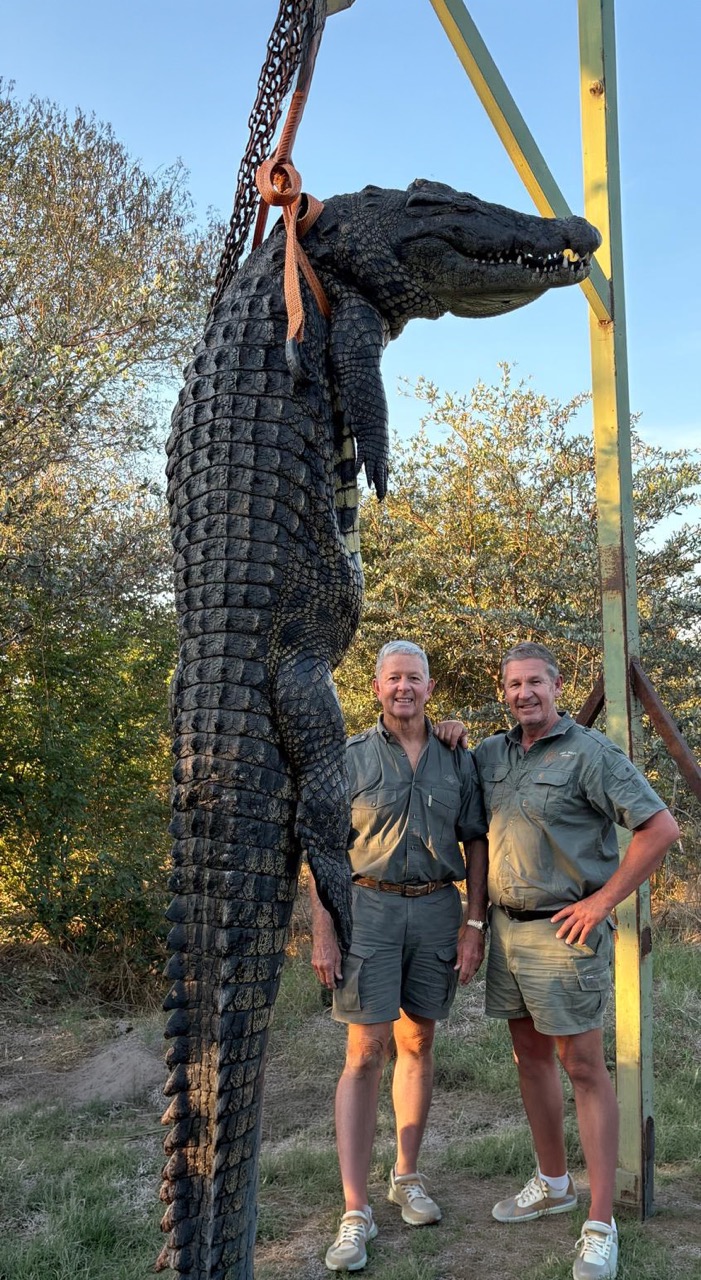
See The Light – Red Dot Scopes Provide Benefits For Hunters

Gerrie Theron
Red-dot scopes provide benefits for hunters that make them capable options when pursuing dangerous game.
By John Geiger
Frederick Selous, W.D.M. Bell and Ernest Hemingway didn’t use red-dot sights on their big-game rifles. But you probably should have.
One modern-day African hunter, Gerrie Theron, recently told me that if there had been a red dot on his .600 Nitro Express when he went in after a wounded Cape buffalo, he might not have been badly gored.
A few years ago, Tabcn was hunting in Limpopo, South Africa, an area known for thick bush and large herds of buffalo. His client made a regrettable shot, and the hunting party tracked the animal for nine hours. Eventually, they determined it was somewhere in the thicket in front of them.
Theron insisted that he go in alone.
“It’s such a dangerous situation,” he said. “I could not have trackers or hunters in there as well.”
Theron crawled on his hands and knees, making his way slowly through the thick thornbush in the mopane forest as the light began to fade.
How a 2,000-pound animal can hide just an arm’s length from an experienced hunter is a mystery. The buffalo charged Theron from 5 yards. Incredibly, Theron got his gun up and fired two rounds in as many seconds into the charging beast. It hooked his midsection and threw him into the air. It then came at him again and trampled him.
Those two bullets killed the buffalo, but not before the bull unzipped Theron’s abdomen. A gash from a horn missed his femoral artery by millimeters. It took 300 stitches to close the wounds at a hospital in Tzaneen, Limpopo.
Gerrie Theron of Theron African Safaris is back in action after being gored by a wounded Cape buffalo. He now uses a Trijicon red-dot sight on his .600 Nitro Express double rifle.
“With light fading, it would have been much better if I had a red-dot sight on my 600 while I was on my knees in the bush tracking,” Theron said. “It gives you an advantage over open sights or peep sights when light is an issue.”
Theron is back to full health and now uses a Trijicon red-dot sight on his double rifles.
The RMR Type 2 Red Dot is one of the most popular red dots for dangerous game.
It has proven to be a durable piece of equipment when all hell breaks loose.
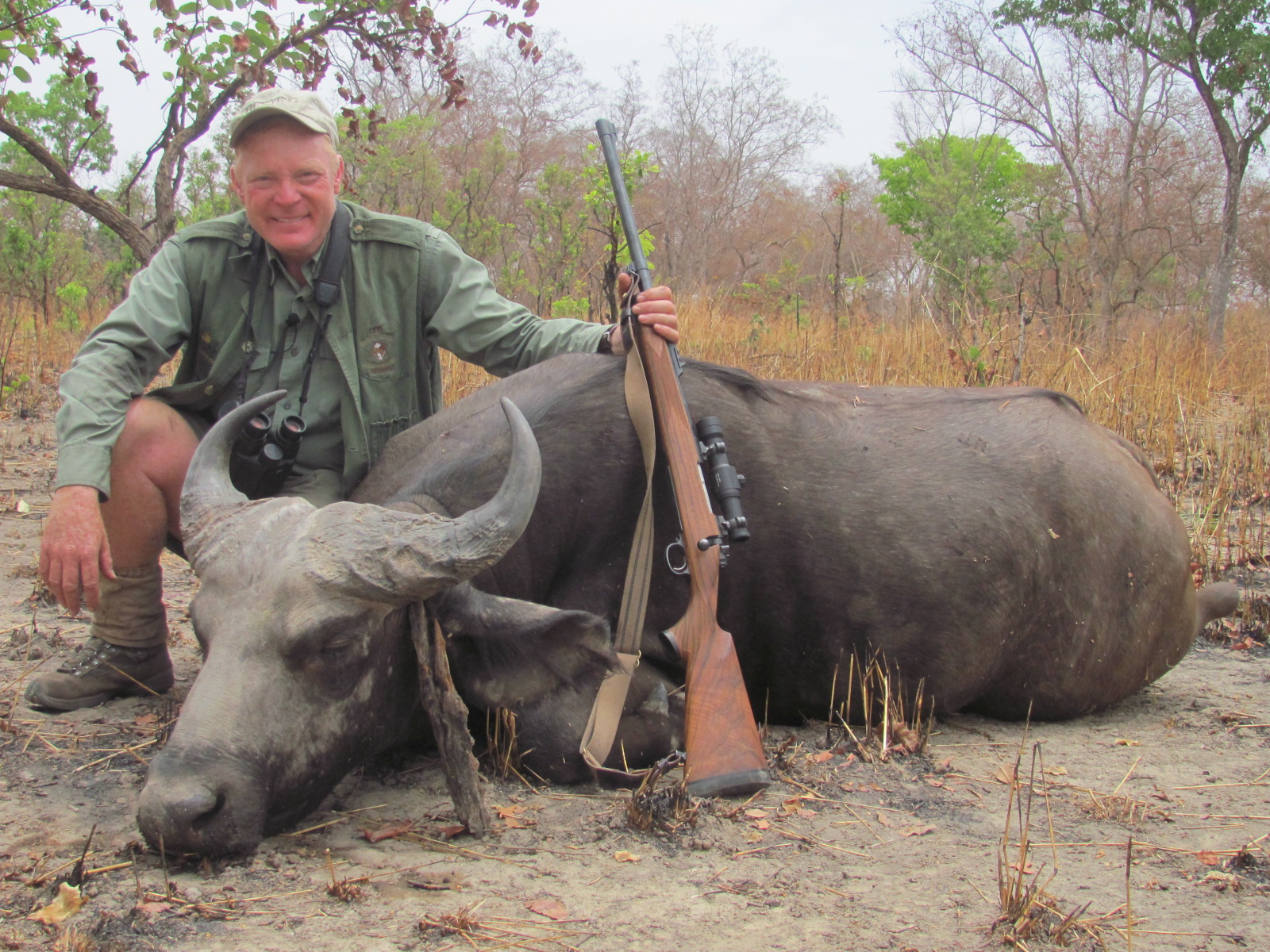
Craig Boddington
Other popular models include Aimpoint’s Micro and 9000 series, Leupold’s Freedom RDS, Burris’ FastFire line, EOTech’s Holographic XPS and Vortex’s Defender Series.
Red-dot optics utilize a low-power light-emitting diode, or LED, to project a beam (which can also be green, or other colors, if you prefer) onto reflective glass. To the hunter, the reflection looks as if the dot were floating downrange. At short-to-medium distances, the bullet goes where the dot is.
Jamy Traut, a dangerous-game guide in nearby Namibia, agreed that red dots excel at helping a hunter acquire the target quickly.
“Red dots let you quickly pick up your target, put the dot on the right spot and pull the trigger,” he said. “That’s exactly what you need for dangerous game.”
Traut, who has been guiding clients in southwestern Africa for nearly 30 years, said open sights, variable tube-style scopes and aperture sights have their place, too.
But, overall, he is pleased when he sees a client pull a rifle with a red-dot sight from its case.
“If they are older, and their eyesight is failing, then a red dot is best for up-close game like Cape buffalo, lion and elephant,” he said.
Thankfully, red dots today are sleek and low-profile.
Craig Boddington wrote about red dots a few years ago in SAFARI Magazine. His friend, Dr. Joe Greenfield, put a reflex sight on his Holland & Holland sidelock
.500/.465.
“I was horrified that anyone would do something like that to such a fine rifle,” Boddington wrote. Eventually, Boddington saw the light. “Recently, I’ve put reflex sights on two double rifles,” he said.
Red dots are much better for aging eyes because of the bright dot, as well as the reduction in the number of visual sight planes. In other words, classic open, iron sights demand that your eye see objects in three different planes: the rear sight, the front sight and the target. If you’re past your 40s, you know that this gets harder to accomplish with each passing year.
Old-style aperture sights and ghost rings allow you to use only two visual planes. The peep “ghosts” the rear sight out of your vision, and you can focus on the front sight and the target.
But a red dot places the aiming point and the target on the same visual plane. You can see both the red dot and the target in the same plane, similar to the way you only look at the reticle when lining up a shot with a variable-power scope.
The difference is that red dots are true 1x magnification. That gives you the tremendous advantage of shooting with both eyes open without tunnel vision.
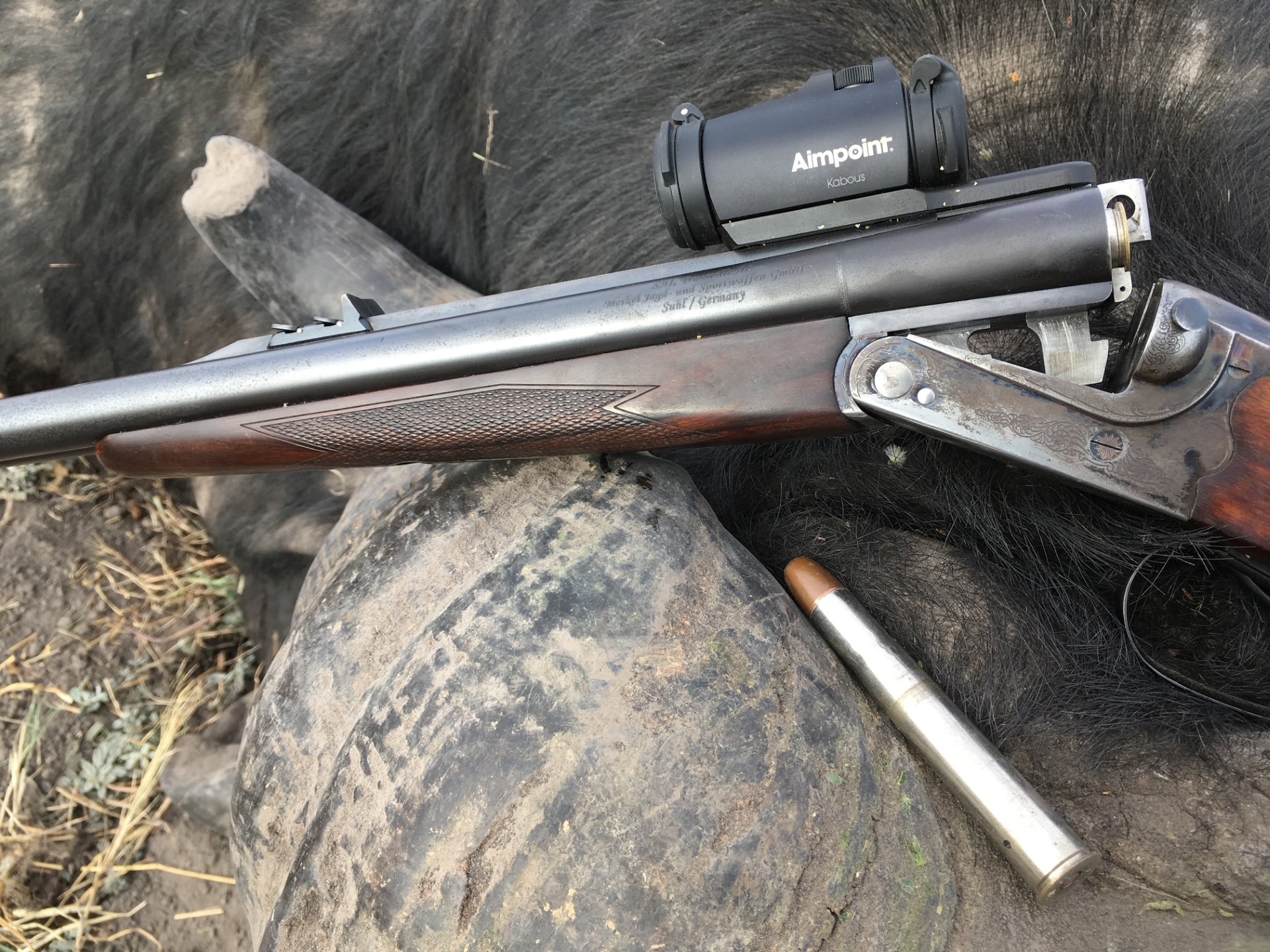
Red-dot scopes
Most hunters, to shut out the distractions around them, close one eye when using a scope of 2x or more. But when you’re hunting dangerous game, you want as much situational awareness as possible, especially when hunting a herd animal, like a buffalo or elephant.
The big red dot, lack of tunnel vision and effectively no magnification mean you’re better able to use your peripheral vision to keep yourself safe and take a natural shot at the animal you intend to put down.
Another advantage of red-dot sights is the lack of parallax. You don’t even need a good cheek weld to accurately hit your target as long as the dot is covering the proper spot on your target. This has helped many hunters out of a jam when a Cape buffalo, lion or any other dangerous game has come right at them with only seconds to raise their firearm, aim and fire.
But there are two African dangerous-game animals that PHs do not recommend using a red dot to hunt: crocs and leopards.
Often, the shot at a big croc is 100 or more yards away. Red-dot sights can be effective for most animals even at that distance, with a 1- or 2-MOA reticle. But on a croc, the aiming point is about the size of a golf ball. That kind of precision calls for a wire-thin reticle in a variable-magnification scope of at least 2x or greater.
Leopards are often hunted and shot in the dark of night. PHs recommend a higher-magnification scope for the precision needed for the hunter to make the right shot in the right place.
For hunters who prefer red dots in a tubular optic, a model like of Aimpoint’s 9000 Series of reflex red-dot sight provides greater precision for that critical first shot.
But if the leopard is wounded and the hunting party must return the next day, older-style open sights are the way to go when — and only when — it’s full daylight. In anything short of full sun, a red-dot sight is best.
Red dots are increasingly popular for use on Cape buffalo. The large bovines are often found in the shade. They are hunted in the middle of the day after morning glassing, and a red-dot sight with variable reticle brightness is ideal for picking out the aiming point on dark skin in the shade.
Traut said 80 percent of his clients use a red dot for Cape buffalo.
One argument against a red dot is that it is a mechanical device and could therefore fail. Another concern is battery failure at the worst possible moment. However, red dots require very little power to illuminate the LED. On the other hand, holographic sights use a laser diode that requires a lot more battery power.
Nowadays, lithium-ion batteries last for years, and most quality red-dot sights have a sleep mode: The sight will turn off until you pick it up again. Both PHs said red-dot technology has never failed them.
“Never. Thank God for that,” Traut said.