
Which Is Better: BDC Or Dialing?

There are two main ways to compensate for gravity’s effect on your bullet. Smart hunters are open to both.
By John Geiger, Managing Editor
We hunters all have our favorite gear. Who doesn’t have a go-to rifle, cartridge, gauge or shotgun that we reach for, whether it’s perfect for the task at hand or not? They’ve worked well in the past and give us confidence as we step into the field, marsh or mountains.
But are we letting comfort or tradition lull us into making a bad choice — one that won’t put the best possible hunting tool in our hands?
One area in particular isn’t getting much attention, but it should. I’m talking about scopes and reticles, specifically how we can use them to deal with gravity’s effect on our shots.
So many hunters I know stick with the trajectory solution with which they are most familiar. Whether it’s a bullet-drop-compensating reticle, also called a BDC, or a system that uses a turret to move the reticle in the scope to adjust for the drop in a projectile’s trajectory, they stick to their guns. But they should be agnostic about these systems and approach each hunt with a new evaluation of each method.
Until about 20 years ago, just about the only people who used dial-turret scopes were military sharpshooters. But, as long-range shooting and hunting has become more popular, especially in the Western United States, turret scopes are now as common — or possibly more common — as those with BDC reticles.
In informal observations at deer camps over the years, it seems older hunters — those who grew up with iron sights or fixed-magnification scopes — lean toward the BDC-style reticle. They’ve used them since they first put glass on their guns, and many get along just fine with that older style.
Among the younger crowd, many were raised on first-person-shooter video games such as Arma 3, Sniper Elite or Escape from Tarkov. These hunters were exposed to the dial-turret style for longer-distance shooting and generally prefer the more modern, military system of dialing a turret to compensate for bullet drop.
Neither camp of hunters — the old bucks or the young ones — is wrong. But neither should they always stick with what they know simply because it’s more comfortable. You could use a hammer to drive in a screw, but there’s a much better option.
“BDC reticles are preferred by some hunters for their speed and quick follow-up shots,” said John Bailey of optics manufacturer EOTECH.
“BDC reticles are typically pretty simple by offering crosshairs for the main zero and 3-4 circles or hashes that the hunter can use for longer distances. This eliminates the time it takes for dialing and eliminates the opportunity for error.”
Bailey noted that all riflescopes can be dialed — that’s how we adjust elevation when we zero them before a hunt.
Some scopes are designed with dialing in mind while hunting, he said.
“This means taller, more tactical turrets that allow better manipulation and also have larger tick and numeric markings. Dialing offers much more accurate adjustment over BDC reticles but does take more time.”
Say you’ve just drawn your coveted tag or locked in a date for an international hunt. Now’s the time to gather the right gear for the type of hunting you’ll be doing.
Some choices, like whether you’re packing cold- or warm-weather clothes, are no-brainers. But which scope system will give you an edge and help ensure you eat backstraps, not tag soup? It depends on what you are hunting and where. Let’s take a look at the pros and cons of each.
Turrets Equal Precision
The turret scope’s main advantage is precision. They are often used with an app that can calculate multiple factors for the hunter (distance, environmental variables and the ballistic profile of your rifle and cartridge) to give you a number. Some call this the “come-up” or “dial-to” number. Whatever you call it, it’s what you need to dial your turret to so that your point of aim matches the point of impact.
For example, on my Revic app, I have a profile built for a Gunwerks Magnus in 7mm PRC. I can range a target — say, 439 yards — enter that into the app, and get a come-up number. In this case, it was 7.0 minutes of angle (MOA), which I then convert to clicks (each click is 1/4 MOA on most turrets) for 28 clockwise clicks on my turret. Now my reticle is positioned for me to hit that target at 439 yards.
There’s a deep satisfaction in knowing you didn’t just get lucky — you used all the information and technology at hand to get a precise holdover and make the shot many others could not. When you hear the “thwap” or the ping of steel at the range, it’s holistic: You, the rifle, ammo, technology and environment feel connected as one.
You did the research ahead of time, learned how to use the scope, how to zero it, how to load your rifle and cartridge’s profile into the app, and how to use that app. In the past, all of that seemed complicated. But with practice, it becomes second nature.
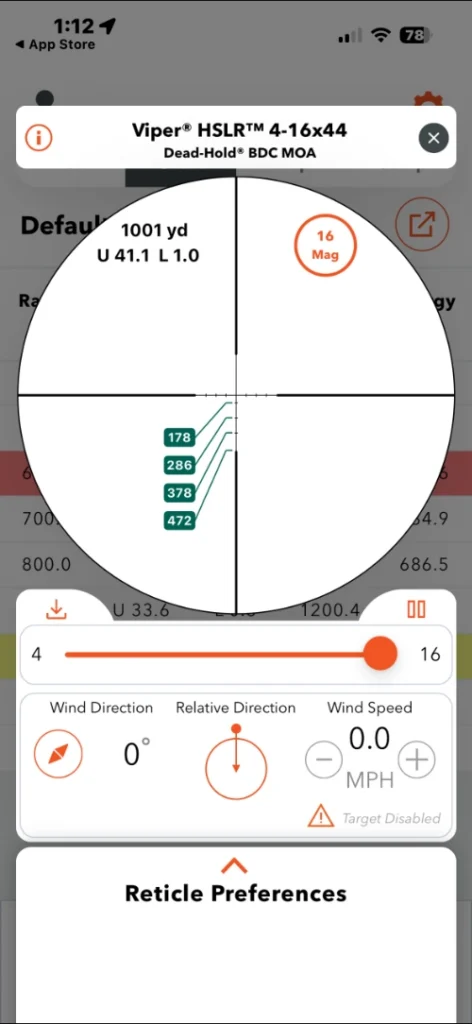
Any ballistic app can calculate the values for the different stadia lines of a BDC scope. Once you’ve written them down, printed them out, saved a screenshot or simply memorized them, you’re ready to confirm at the range and go hunting.
Cleaner Sight Picture
Another advantage of the turret system is a cleaner sight picture. The reticle in a dial-turret scope is often exceptionally clean — just one vertical and one horizontal line. Once it’s dialed, there’s no confusion.
Show me a gun hunter who’s never used the wrong stadia mark or a bowhunter who’s never used the wrong pin, and I’ll show you a jackalope on the hoof.
BDC reticles, on the other hand, will typically have at least three stadia lines, and often they’re not marked with numbers or further information. I hope you remember your holdovers and that the paper printout taped to your stock doesn’t get too muddy to read.
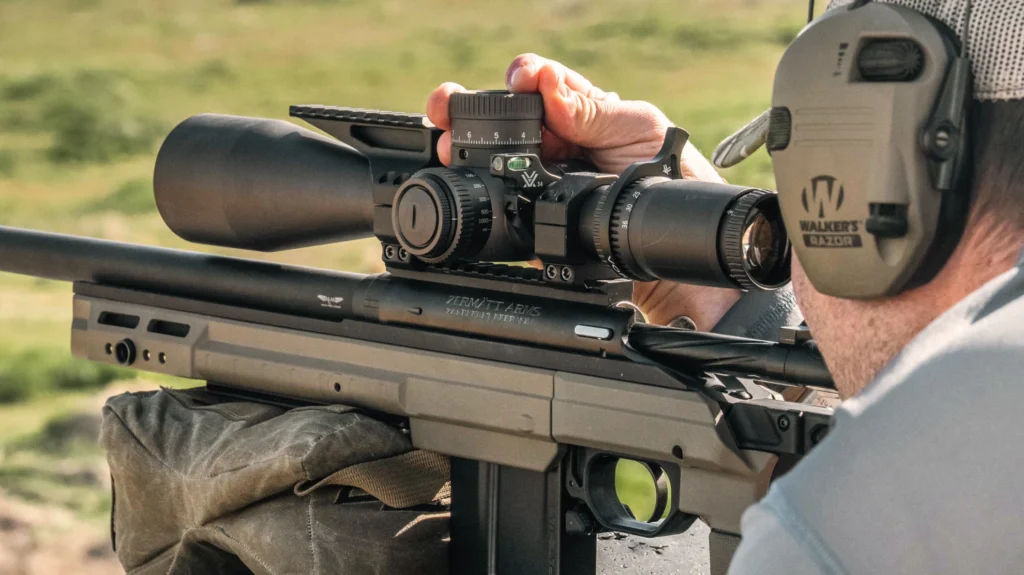
A hunter at a range confirms that his Razor HD Gen III 6-36X56 FFP with an exposed dial-turret is ready for hunting. While dial-turret scopes let you be more precise at long distances as compared to BDC reticle-scopes, hunters should always get as close as possible to their target animals. Practice long-distance shots at the range so you are ready for the ethical shot opportunities that present themselves to you while hunting.
Another major advantage of a turret scope and ballistic app is the technology’s ability to compensate for factors a hunter can’t even detect — specifically, barometric pressure, elevation and other variables that affect a longer-range shot.
A good ballistic app — Hornady’s 4DOF, Revic, Applied Ballistics Quantum or GeoBallistics, to name a few — will take into account how local air pressure, elevation and even wind will affect your bullet’s path through the air.
Even more subtle influences, such as spindrift and the Coriolis effect, become important factors at longer ranges. Spindrift is the bullet’s lateral drift caused by the barrel’s rifling. The Coriolis effect refers to the change in a target’s location caused by Earth’s rotation between the moment a bullet leaves the barrel and when it reaches the target. Put simply, the target is in one place when you pull the trigger and in another (slightly higher, if you are facing east) when the bullet arrives. Try calculating that one on the fly!
These advantages of the turret-dialing system are remarkable technological accomplishments. The app on your phone completes countless calculations in milliseconds.
Practically speaking, dialing is the best option if you are hunting animals you can’t get close to because of deep valleys, mountains or wide-open spaces you can’t cross without being detected. In these cases, you need precision — and time to gather all the factors — before you send that first, all-important bullet.
A few years ago, I was hunting in eastern New Mexico when I walked up on a buck and two does bedded in high grass. They ran down the side of the butte. I knew they would eventually stop to look back and see what had spooked them.
That gave me time to find a clear spot, set up my bipod, wait to get a range when he looked back and enter it into my app for the perfect holdover. When you have the time, you can’t beat the dial-turret scope.
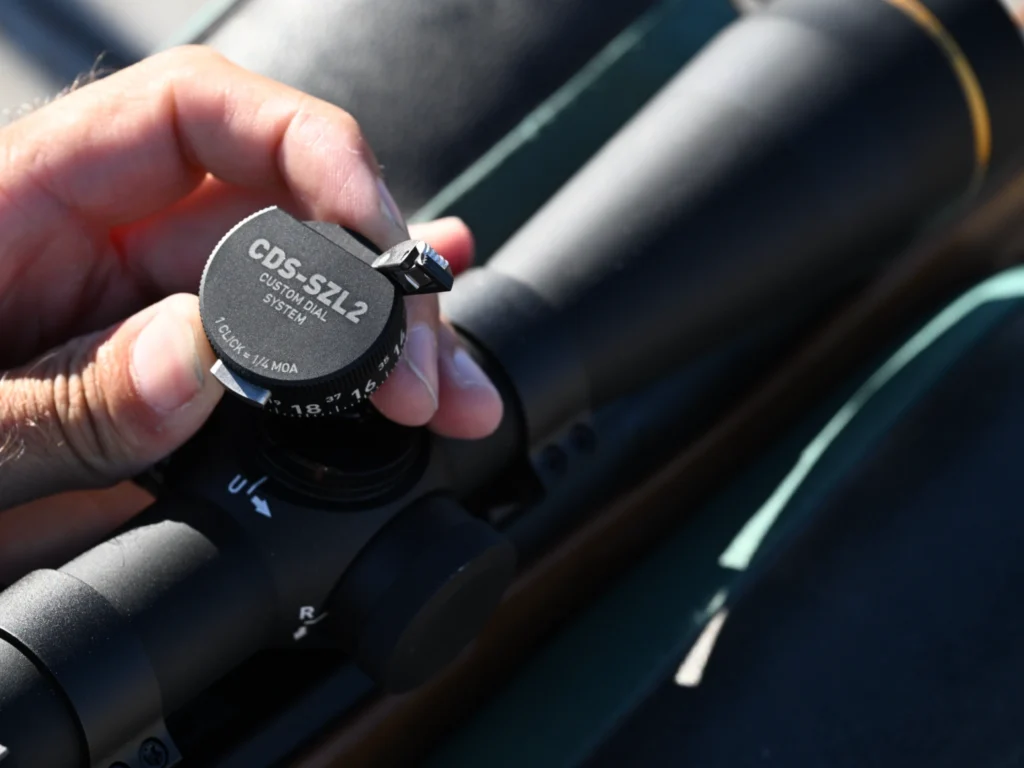
Leupold and other scopemakers offer a Custom Dial System that replaces your elevation turret with a laser-etched cap matched to the ballistics of your rifle and load, allowing you to dial to the yardage of your target. This solution is most accurate when environmental conditions closely match those used to create the dial.
BDC Reticles Are Faster
In the dense hills of North Georgia, where I do much of my hunting, deer play hide-and-seek among the pines and hickories all day. There’s no time to dial — often no time to blink.
These deer may appear for the first time at 30 yards or 200; you never know until it happens. A BDC reticle is perfect for this kind of hunt because time, not distance, is your challenge.
The same goes for a hunt in the North American boreal forest, European taiga, Limpopo mopani forests, Texas mesquite flats or the bayous of Louisiana — in these environments, a dial scope could be a liability.
A BDC reticle can be zeroed so your center crosshairs are the hold for, say, 100 or 200 yards. For longer shots, you can set up the stadia lines, or hashmarks, below to correspond to farther targets. Deciding which stadia marks to use is much faster than typing a range into an app, converting the resulting data to clicks and dialing in your turrets before you pull the trigger.
Less Chance Of Error
Besides being faster on fleeting, close targets, a BDC is also just simpler. The sight picture may have more hashmarks than a turret scope, but there’s no app, iPhone, Wi-Fi or Bluetooth, no ballistic profile and no dead batteries to ruin your hunt. Plus, you never have to remove your eye from the ocular lens once you acquire your target.
A BDC-reticle system, however, also requires research and range work — just like a turret scope — to confirm your point of aim matches your point of impact at various distances.
You’ll need to use an app or info from a website to get an idea of what distance each stadia line corresponds to for your chosen cartridge/load. They likely won’t be nice round numbers like 200, 250, 300, 325 or 350 yards. Instead, they’ll be more arbitrary — like 208, 267, 319 or 342 yards.
To determine the distances for each stadia line, go to the scope manufacturer’s website and look for a chart or app where you can enter your rifle, ammo, barrel length, muzzle velocity and other factors. Once you’ve input all of this information, it should be able to provide you with where your particular setup will print bullets at different distances.
Then, just as if you are using a ballistic app with a turret scope, go to the range and confirm the accuracy of the info. Once you have your dope, save a screenshot, print out a chart or memorize the distances. In the field, when you need to take a shot beyond your maximum point-blank range, simply range the target and use the closest stadia.
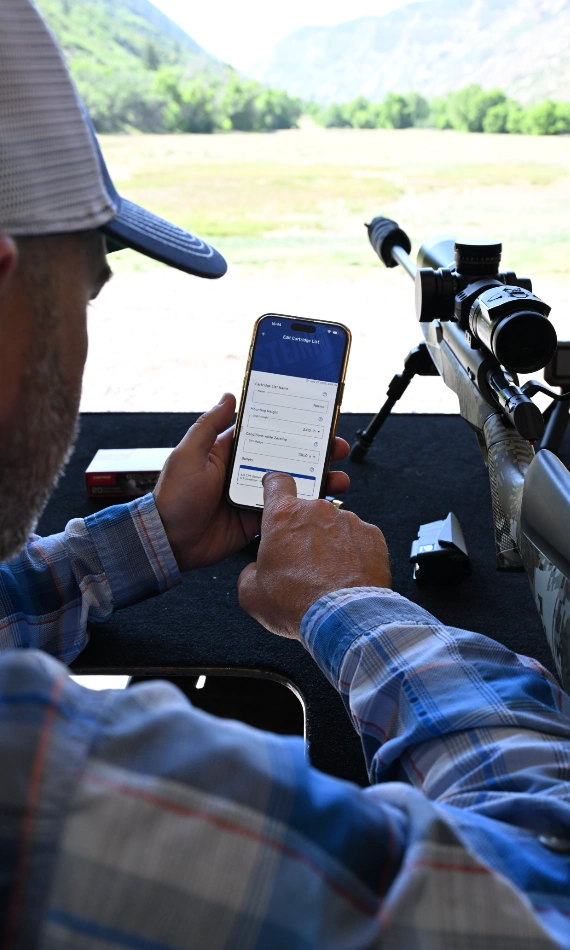
The right time to set up a dial-turret scope is at the range, well before the hunt, where you can confirm your point of aim will be the same as your point of impact.
Focal Planes
One beginner mistake can occur at this point. If you’re using a second-focal-plane scope, it must be set to maximum magnification for the stadia lines — and the subtensions between them — to match the bullet’s drop. As you turn the magnification dial, the stadia marks and subtensions in second-focal-plane scopes remain the same size while the target gets larger or smaller. An advantage is that the lines are always visible, but at longer ranges, they may be too thick for precise aiming.
According to Swarovski, most North American deer hunters prefer a second-focal-plane scope. That’s why the company made its recent Z5+ line all second-plane optics — to satisfy American hunters who grew up with and are familiar with them.
Conversely, in a first-focal-plane scope, the reticle grows and shrinks with the target image, so the subtensions remain constant at all magnifications. A downside to this is that, at close ranges the stadia lines may be too thin and at long ranges too thick. Scope manufacturers try to mitigate this issue by offering reticles with very thin center crosshair wires that get thicker toward the outside of the sight picture.
Classic Blunders
I could see a hunter who uses a turret laughing at a buddy who uses a BDC reticle when he misses a shot because he forgot to turn his magnification up to maximum before pulling the trigger. I’ve been there at different times — both as the hunter who laughed and as the hunter who didn’t.
But it can go the other way, too. That same turret-scope hunter who laughed could be the butt of the joke when he forgets a crucial step: returning the dial to zero.
When you dial, always start at zero, then dial to the number you need. Whether you shoot or not, it’s crucial to return the turret back to zero before engaging another target. If you forget, you might not realize that the dial is still set at 3, 10 or 20. On your next target, you could accidentally add your new holdover to the old setting and shoot well over the top.
Which might be funny to your buddy, but not to you.
Either way, we’ve covered some of the advantages and disadvantages of both BDC and turret scopes. Which will you use on your next hunt? If you’re after blue sheep in the Hindu Kush and expect a long shot at an animal that you must drop on the spot, consider a turret system. Hunting moose in the tight willows of an Alaska river bottom? Then a BDC might be your best bet.
But life is messy. Sometimes it’s hard to know which will be best for your next hunt.
It’s Good To Have Options
Ryan Muckenhirn of Vortex planned to use a dial turret on an antelope hunt, but switched to Plan B — a BDC-reticle solution — when things got Western.
He first glassed a bruiser antelope at about a mile out. After a stalk, the buck was just beyond 350 yards. Muckenhirn got a good range, entered it into his Global Ballistics app and dialed the minute-of-angle number it displayed.
But the goat kept moving, and he couldn’t get off a good, ethical shot. Then the antelope dropped into a drainage. Muckenhirn turned his turret back to zero (so his friends wouldn’t laugh at him), got off his sticks and moved to a vantage point where he could see the goat come out of the slough.
The buck came out at 286 yards — nowhere near where Muckenhirn predicted. The top-heavy goat was about to slip into more shadows and perhaps out of his life forever.
Thankfully, Muckenhirn had a reticle in his turret scope that could double as a ballistic reticle — it was a hybrid. Muckenhirn ranged the buck, put the second stadia line on its vitals and pulled the trigger just before it entered another draw.
“At first, it was a technical turret-manipulation shot with time to take it,” Muckenhirn said. “But it quickly turned into a shot where the BDC reticle was the best option for success — and it worked great.”
Muckenhirn’s reticle — a VMR-3 MRAD — on his exposed-turret Viper-HD 3-15x44mm could be used like a BDC reticle. It’s a bit more complex than a typical turret-style crosshair reticle, but he’s an expert with his gun and scopes, and he practiced nearly every day with this setup for a while prior to the hunt. A less experienced shooter, or someone who gets buck fever, might have blown this scenario and still be looking for a wounded antelope.
Most scope companies make turret scopes with BDC options. The purists among us may not go that route, but if it fits your hunting scenario, the option is there.
BDC, turret and hybrid scopes are all effective, but each has pros and cons. The right choice depends on the kind of hunting you plan to do. Whichever option you choose, spend plenty of time at the range to get familiar with your scope solution and confirm that your rifle will hit where you expect it to at various distances within your maximum ethical range.
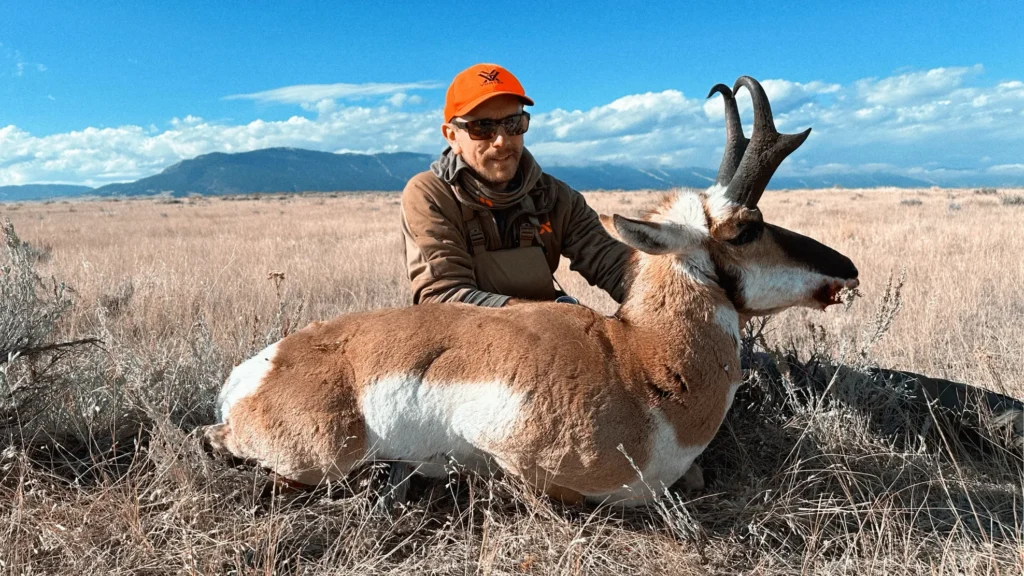
Ryan Muckenhirn of Vortex planned on using the turret on his scope to get a precise aiming point at a fine antelope. “But it quickly turned into a shot where the BDC reticle was the best option for success — and it worked great.” Thankfully, the VMR-3 MRAD reticle in his Viper-HD 3-15×44 could do both.