
Eyes on the Prize

Outfitters share their top optic picks for successful hunts.
By Jack Orloff, Associate Editor
Choosing the best binocular, spotting scope or riflescope depends on the game animal you’re pursuing. For expert insight, we spoke with outfitters and professional hunters from around the world about their preferences for optics when hunting specific species.
Drake Dawson, SCI’s 2014 North American Professional Hunter of the Year, operates mostly white-tailed hunts in central Missouri.
“It’s whitetail nirvana out here,” said Dawson of Safari Unlimited. “But we aren’t taking crazy long-range shots like some of the guys out West. It’s rare for us to take a shot longer than 300 yards.”
Dawson grew up using Leupold riflescopes and still has one mounted on a rifle he received as a gift after graduating high school. He has stayed loyal to the brand and now relies on the Leupold VX-Freedom 3-9x50mm Firedot Twilight Hunter.
“Lots of times we’re shooting through timber or brush in low-light situations, so we need a riflescope that does the job and can drive a tack through there,” Dawson said. “The VX-Freedom 3-9×50 has the ideal magnification for the type of hunting we do, and it’s easy to use. The illuminated aiming point helps, especially in the early mornings and late evenings in the woodlands and fields of Missouri.”
Dawson also noted that the scopes in the VX-Freedom line are affordable.
Katie Dugan of KD Outfitters hunts red stag, fallow deer, Himalayan tahr and chamois on New Zealand’s South Island. She prefers the Swarovski Z5 3.5-18x44mm riflescope for its clarity and versatile magnification range, which allows her to carry less gear in the field.
“When we’re in big-mountain country, you could see a deer or a tahr, and it’s good to have something that does it all,” Dugan said. “We try to get as close as we can to an animal. A typical shot is about 200 yards. But with my rig, I can reach out to 500 yards, although I try not to go past that for ethical reasons. The quality of the glass and the magnification does the business.”
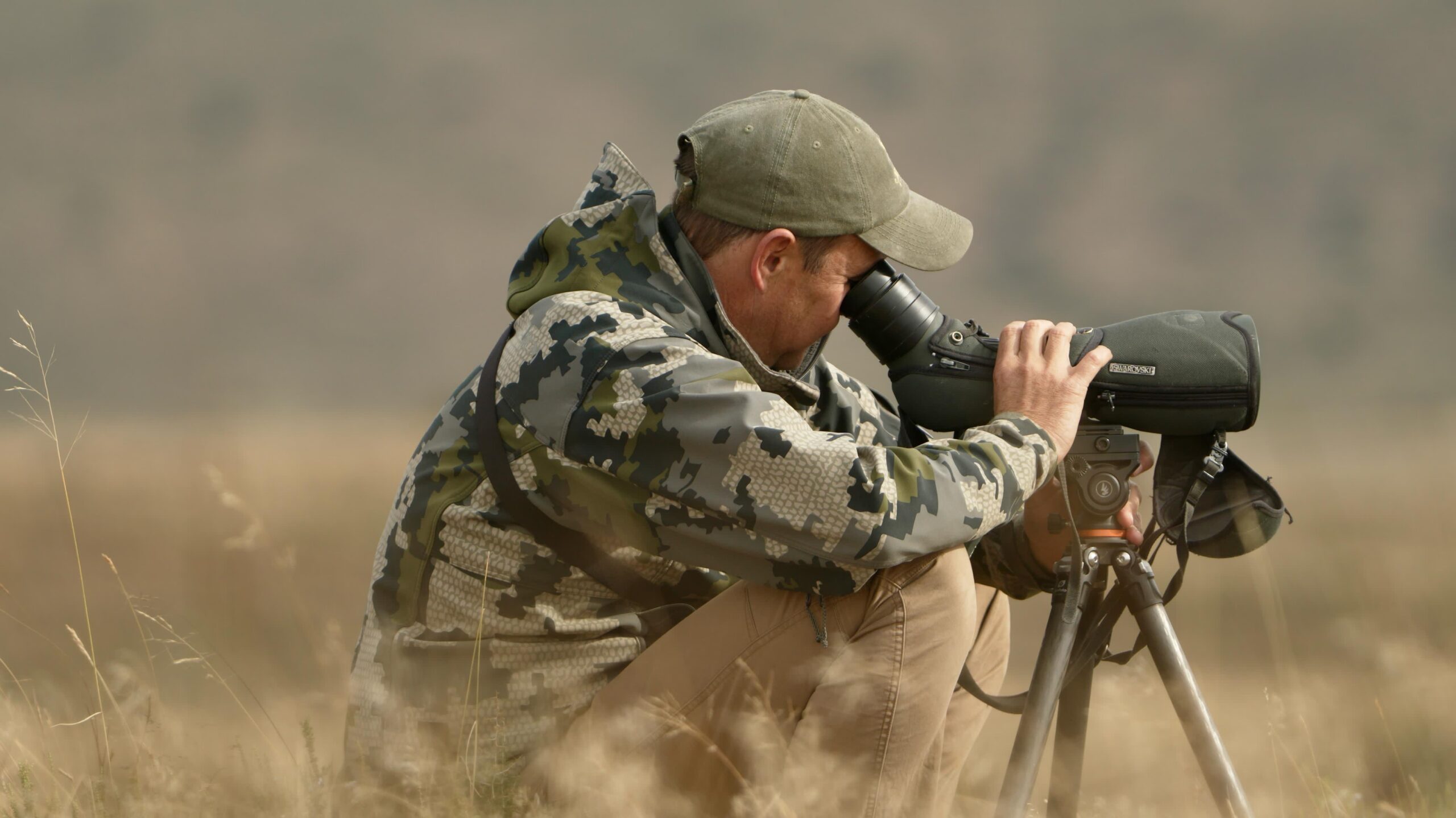
Carl Van Zyl scans the landscape in South Africa’s Eastern Cape for game using his Swarovski ATX 25-60×65 spotting scope.
While having the right riflescope is important, Dugan said good glass on a spotting scope is invaluable for judging different species.
“Generally, with deer you’re getting close enough to judge trophy potential. But with tahr and chamois, you really need to get a good look to determine if they’re mature animals,” Dugan explained. “They may be in treacherous territory, so you want to be sure the animal you’re pursuing is worth the effort.”
She uses the Swarovski ATS 20-60x with an 80mm objective lens, which provides clarity and detail — even in low light — thanks to the wider exit pupil. This lets her quickly determine if an animal is a shooter, saving time and energy.
Dugan also stressed the importance of a good tripod for your spotting scope.
“It’s always a trade-off,” she said. “You want something sturdy and quick to assemble, but also light enough to carry up the mountain.”
Carl Van Zyl of John X Safaris hunts a variety of plains game and Cape buffalo. The abundance of species and varied terrain in South Africa’s Eastern Cape means his optics requirements change with each hunt. For riflescopes, Van Zyl uses several brands and models.
“For our rifles, ranging from .243 Winchester to .416 Rigby, depending on the game we are hunting, we use Revic, Nightforce and Swarovski scopes,” Van Zyl said. “For my dangerous-game backup .416 Rigby, I use the 3-MOA Vortex Razor red-dot sight. All have their purpose and have proven reliable for our needs.”
Van Zyl said he likes using the Revic Radikl RS25b 4-25x50mm because of its onboard ballistics. It’s a smart scope with ballistic technology built in, connecting via Bluetooth to the Revic app and eliminating the math and guesswork.
“For spotting scopes, I use the Swarovski ATX 25-60x65mm. It’s in a league of its own and has seen more miles on my shoulder than most folks travel in their lives,” he said.
“It’s a must in my equipment lineup and the biggest contributor to successfully implementing our age-based hunting model,” Van Zyl said. “It allows us to study game sufficiently before embarking on a stalk, making informed decisions to hunt mature animals.”
For plains game, Van Zyl uses the Revic Acura BR10 Gen 2 10x42mm binoculars.
“They’re sturdy and solid when it comes to wear and tear, and they perform beautifully at both traditional and long-range requirements out in the field,” Van Zyl noted.
Another feature Van Zyl likes is the built-in ballistics.
“The ballistic engine is in a league of its own for real-time solutions in the field. No need for apps, graphs or long calculations — just range, input wind speed and direction into the binoculars, and a second later you have an accurate solution to your shot,” Van Zyl explained.
After using the first generation of the binos, Van Zyl said the Gen 2 product offers significant improvements.
“I had the Gen 1s and was impressed. The Gen 2s are just as good, if not better, with more options,” he said.
For Cape buffalo, Van Zyl uses the Swarovski EL 10x42mm binoculars with the built-in rangefinder. Although range-finding isn’t as crucial at short distances — buffalo are usually taken at between 70 and 100 yards — their low-light capabilities make them a winner.
Van Zyl isn’t the only one who’s a fan of the Swarovski EL 10x42mm binoculars. Robert Lindores, a guide with Vancouver Island Guide Outfitters, located in Port Alberni, British Columbia, said he’s found the ELs to be perfect for spotting bears.
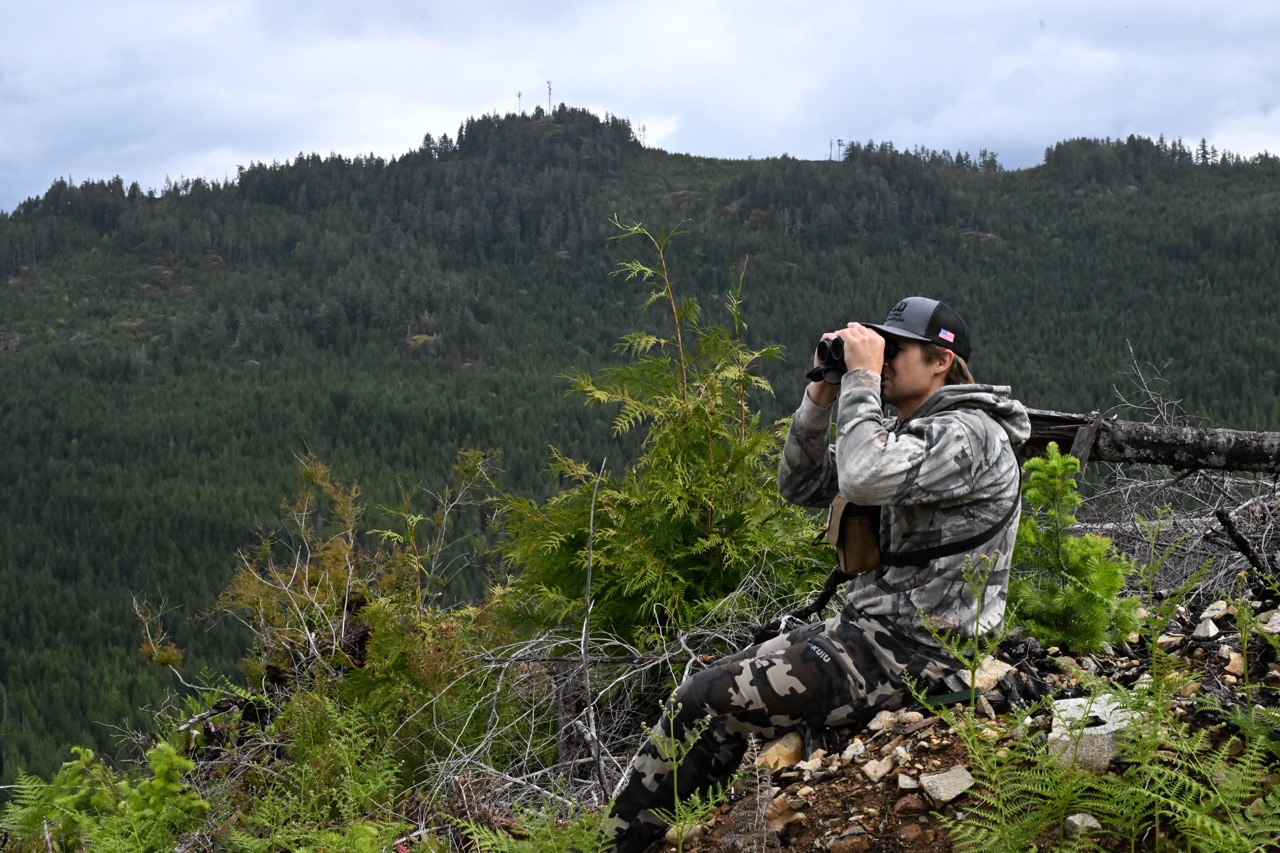
Robert Lindores of Vancouver Island Guide Outfitters, based in Port Alberni, British Columbia, examines a potential shooter during the spring bear season.
“We might be glassing spring bears, walking in and out of the shadows of the timber. With the Vancouver Island bears being completely black, they can be tough to judge at a distance,” Lindores said.
“The quality of the glass in the ELs allows me to see detail on black-on-black, which helps me judge whether an animal is special enough to go after,” he said. “They are a real difference-maker in low-light conditions. With the built-in rangefinder, you can eliminate another item in your pack and have it all in one tool.”
Almost all the professionals we spoke with stressed the importance of durability and working with companies that offer strong customer service. Many of these guides and outfitters need to replace glass every few years because of the wear on their equipment.
“We are putting our optics through a pretty good workout as we hunt and track through the thicker areas,” Lindores said. “They will get bumped, they will get dragged through salal and salmonberry bushes — it’s just the way it is. I buy products from companies that understand what we do and how important their product is to our success.”
Lindores said a solid warranty on optics will save hassle, money and time out of the field.
The right optics are more than just gear. They’re an essential part of the hunt. Investing in the right glass for your hunt can mean the difference between success and watching an opportunity slip away.
It’s always a good idea to contact your outfitter before a hunt to ask about what types of optics work best in their area. Hunters can make smarter choices by consulting their outfitters ahead of time and get the most out of their optics in the field, no matter what game animal they are pursuing.