

The Grace of The World

Hunting Wild Black Bears In The Mountains of Vancouver Island Was Far More Than The Pursuit Of A Trophy
By Jack Orloff, Associate Editor
Originally published in the 2025 November/December issue of SAFARI Magazine.
“For a time I rest in the grace of the world, and am free.” — Wendell Berry
As much as hunting can be and is a search for game, it also can be a quest for meaning — the meaning of our lives, our dreams and our challenges.
So, when a hunt brings hunters from different backgrounds and life experiences together with a dual purpose — a hunt for bears and a hunt for shared solace — it transcends to another level.
Family and friends had gathered around the fireplace in a grand log cabin located on Vancouver Island. They enjoyed sundowners and appetizers while reminiscing about the day’s adventures and life’s challenges.
One thing brought all these people together under the same roof. It’s a passion they share and love. An honored ritual that has been passed down from generation to generation. It is the hunt. But it was more than just that.
It all started with the William Laird Hamberlin II Memorial Scholarship Fund. It’s a scholarship fund established by Safari Club International Foundation for students in Auburn University’s College of Forestry, Wildlife, and Environment with a declared major in wildlife ecology and management or wildlife enterprise. William was the son of SCI and SCIF CEO W. Laird Hamberlin. The scholarship honors William, who passed away in a climbing accident in Peru in 2021.
William grew up in Cumming, Georgia, before his family moved to Singapore, where he attended the Singapore American School and graduated in 2009. He then went on to graduate from the University of British Columbia in Vancouver, Canada, with a Bachelor of Science in Sustainable Design in 2014.
He also carried on his father’s legacy as a member of the Kappa Sigma Fraternity.
Will had an adventurous spirit and a genuine appreciation for nature and traveling the world. He was a hunter and a fisherman, but more importantly, he was an amazing person.
Over the past few years, a spring black bear hunt, generously donated by Darren DeLuca of Vancouver Island Guide Outfitters, has been auctioned at the Sables Luncheon during the SCI Convention, with the proceeds going towards the scholarship.
DeLuca began Vancouver Island Guide Outfitters in the 1980s after purchasing a large guide area from his father-in-law, who had been one of the first outfitters on the island. Since then, DeLuca has earned an excellent reputation for producing consistently good black bears, which he considers to be adult boars weighing 250 to 400 pounds.
“Laird and I were introduced through friends, and then, of course, I heard the news about the loss of his son,” recalled DeLuca.
“They had announced that they were going to create a scholarship in his name, so I reached out to Laird and his wife Katie and said, ‘Look, I’d like to donate a hunt to Will’s scholarship fund,’ and that was how it all started. This is the third year we have been doing it,” DeLuca explained.
In 2023, the hunt was purchased by Doyle and Jamie Worbington. Doyle is a retired Army Ranger. He and his wife, Jamie, own and operate J&D Outfitters, one of the largest hunting outfits in the state of Colorado.
Worbington grew up in the Mississippi Delta with Hamberlin, and the two reconnected again years later after both families suffered tremendous losses.
“Jamie and I lost our son Austin in 2016,” Doyle recounted.
“At that time, we had rekindled our relationship with Laird and his family and our mutual friend James Holloway, who came with us on the hunt in 2023. James and his wife had also lost their daughter when she was 14, so you had three childhood friends who had all lost a child and were here hunting together. It was a really good experience for us to do that together,” said Doyle.
The following year, in 2024, Worbington, along with friends Charles Jackson and Barry Coggeshall, decided to purchase the hunt again at the Convention, but this time, they did not buy it for themselves. They bought it for close friends Jenn Prock and her family.
“I was really impressed with Darren’s operation, so later that year in 2023, we found out that our close friend Jenn Prock had been diagnosed with metastatic breast cancer, so we decided to buy the hunt for her in 2024,” said Worbington.
Doyle and Jenn’s husband, Zach Prock, have been friends and business partners for years, co-owning and operating Cross Mountain Outfitters together near Craig, Colorado.
“I had the land, and Doyle had the clients,” said Zach.
“We started doing a few hunts together. I had some big deer, and he had some good clients, so I started helping him by taking a few of his clients. We started on Cross Mountain Ranch and created Cross Mountain Outfitters, and now we have four ranches with three up in Craig and one in the southwest corner of Colorado,” Zach explained.
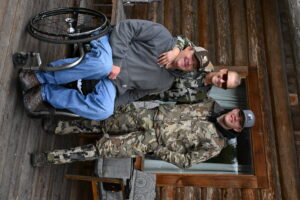
The Prock family on the front porch of the lodge before heading out on the water to the estuaries in search of black bear. Shown, from left, are Zach, Jenn and Trevor Prock.
However, due to medical reasons, Jenn and her family were unable to make the trip to Vancouver Island in 2024.
“Since Jenn couldn’t make it, Darren agreed to move the hunt to 2025, so we were able to bring Jenn and her family,” Worbington said.
In May 2025, the Worbington and Prock families, accompanied by Laird, arrived in Port Alberni, British Columbia, ready for an adventure to hunt spring black bears and make lasting memories.
The Prock family is truly incredible. Zach runs many successful businesses, including 15 different LLCs, which include co-owning Cross Mountain Outfitters in Colorado with Worbington. Zach is in a wheelchair from an accident when he was 19 years old but can do just as much or more than most people who can walk on two feet. His wife, Jenn, is a charismatic, charming, witty and strong lady, as well as an outstanding mother to her 17-year-old son, Trevor, who is an honors student who loves to hunt but is also a tremendous football player at his high school.
Jenn and Zach first met in the 5th grade and began dating later in high school. They have been inseparable ever since.
On this hunt in May, Jenn would be the primary hunter. But Zach, Trevor and I also had tags.
Each morning at Vancouver Island Guide Outfitters began with the group convening at the breakfast table to talk game plans for the day over a cup of coffee and a fantastic breakfast spread. Then, groups were split up and led by different guides as they made their way up nearby logging roads or by boat on estuaries in search of the elusive Vancouver Island black bear.
Driving up through the clouds and mist revealed incredible views of snowcapped mountains covered in fir trees and moss. Light rain and mist would come and go, followed by occasional sunlight, which was usually short-lived.
It was one of the most beautiful places imaginable. Each twist and turn brought a different and unique scene that was truly breathtaking.
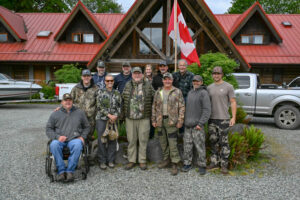
The group gathers after breakfast before the morning hunt. Shown, from left, are Zach Prock, Trevor Prock, Matt Dunk, Jenn Prock, Rick Chappell, W. Laird Hamberlin, Jamie Worbington, Doyle Worbington, Darren DeLuca, Ted Chappell, Mike Oleshak and Robert Lindores.
Following the day’s hunt, the group would return to the cabin and gather around the fireplace, sipping cocktails, nibbling on appetizers and enjoying each other’s company before sitting down at the long wooden table in the main room to share stories of bear sightings and close calls over a first-class dinner prepared by chef Matt Dunk.
On Day 2, I was partnered with guide Mike Oleshak, who had been guiding since 2000 and had a knack for finding bears.
“In the early season, we target bears in the first green locations where there are green grasses along roads and cuts as well as estuaries on the ocean,” Mike explained while driving his truck up the bumpy logging road.
“Then it transitions into the rut where the bears are moving more. We look for places where the sows live as much as the boars because the boars are looking for the sows, so they are starting to move around and break their sticks to mark their territory,” he said.
Mike also told me what signs to look for.
“When you find lots of crap on the road or in a spot, and if it’s fresh, it’s definitely a place you want to be,” he said. “In the afternoons, around 3 p.m., bears start moving a bit. Then 6 p.m. is when they start feeding, and the last hour of light is when we see the most bears.”
Although it was getting late in the afternoon, and we hadn’t seen any bears yet that day, we still had one more clearing to check out. As the fog and rain pelted us, we made our way up another steep logging road, weaving around potholes and dips, our eyes peeled for black bears in the vast cuts.
As we came around a bend, Mike suddenly put the truck in park and took out his binoculars.
“That’s a bear. That’s a good bear!” he said excitedly while looking through his binos.
I quickly exited the vehicle and began loading the camp gun, a Sako in .338 Win. Mag.
“Shoot that bear,” Mike whispered as I tried to calm my nerves while putting up the shooting sticks.
At the crack of the rifle, the bear jerked back and went down in a heap, but quickly got back up and began making a run for the thick forest.
“Shoot him again, quick,” yelled Mike.
I quickly chambered another round and put a second shot into the bear, who was on the move. I watched him flinch again as he fell along the tree line at the edge of the road.
At about 115 yards, my first shot had hit the bear in one of the shoulders and into the vitals.
As I made my way down to the bear, I put my hand on his big black head and thanked the animal and God for the opportunity.
I had successfully taken my first-ever black bear — a good bear measuring 6 feet.
It was a trophy and an experience I will not soon forget.
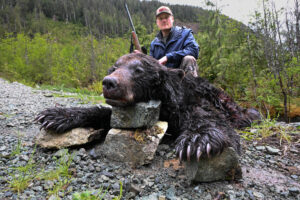
Author Jack Orloff used a Sako rifle in .338 Win Mag to take his first black bear.
The next few days were spent again cruising logging roads and seeing the occasional bear, but none were big enough to take.
On Day 3, Jenn, Zach and Trevor decided to hunt the estuaries by boat that lead into the Pacific Ocean. They went with guides Ted Chappell and his nephew Rick Chappell
Since Zach was in a wheelchair, he was granted a Disabled Hunting Permit by the British Columbian Ministry of Water, Land, and Resources Stewardship, which allowed him to discharge a firearm from a motor vehicle intended for people who are unable to safely exit a motor vehicle or position themselves on uneven terrain. It also entails a hunting companion, authorizing a physically disabled person to be assisted by having one or more hunting companions kill and retrieve big game.
Although the Prock family had many bear sightings on the water that day, THE ONE just didn’t show up.
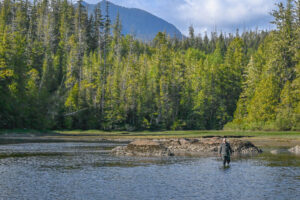
Guide Ted Chappell gets a closer look at a potential bear sighting on the shoreline of the estuaries that lead into the Pacific Ocean.
On Day 4, the last full day of the trip, Jenn, Doyle and Jamie, accompanied by guides Robert Lindores and Mike Oleshak, hit the logging roads in search of a good boar that Laird had been hunting all week but had to leave early for an SCI meeting in Europe.
As the hunting party made its way up the rugged logging road where it had been seen, the bear was nowhere to be found.
The team decided it would be smart to have another set of eyes on the clearing, so they dropped Mike off at a vantage point to glass while the rest of the crew continued up the logging road in search of other bears.
At around 2 p.m., Mike reported good news.
“I found him. He’s in the clearing, feeding,” he said.
The crew quickly made their way back down the logging road, conducting their stalk of the bear as Mike continued to watch through his binoculars from the vantage point.
Jenn led in front of the pack with Robert, while Doyle and Jamie stuck close behind.
As they continued forward to where the bear had been seen feeding between the fallen logs, the crew still had no eyes on the boar.
“I was the first one to see him,” Jenn recalled. “He was feeding about 100 yards away when I spotted him.”
Robert quickly put up the shooting sticks for Jenn, and she took aim.
Her first shot, which was angled uphill, connected beautifully.
Although it was a good hit, the injured bear took off back up the hill.
The hunting party continued forward while keeping a close eye on the bear.
Suddenly, the bear turned back down the hill — a good sign of significant injury.
Robert put up the sticks again, and Jenn took another shot, which again connected.
One last insurance shot anchored the big boar, resulting in Jenn’s first Vancouver Island black bear!
High-fives, hugs and shouts of excitement erupted through the valley. Jenn’s smile was contagious as she knelt next to the bear, laying her hands on its beautiful pitch-black fur, which had no rubs and was in pristine condition.
Pictures were taken as the group replayed the excitement that had happened moments before.
At that moment, nothing else in the world mattered. There were no worries of the past or the present. The stress of work or finances, even something as scary as cancer, was not on their minds. The everyday struggles and hardships seemed to disappear. The only thing on their minds was that special moment. A moment that stood still in time.
Sometimes, life takes unexpected turns, and sometimes, they can seem unbearable. But when you’re out in the wild and closing the distance on a big black bear and getting ready to take the shot, nothing else in the world matters — not work, not finances, not illness. Pains of the past and present can go right out the window.
From the time I spent with Jenn, although fatigued at times, as we all were from the long days, Jenn never let down her smile. She was always enthusiastic, eager to chase bears and enjoyed every moment of the hunt. Her infectious spirit was truly inspiring, showing her character and the exceptional person she is.
“She is one hell of a strong woman, and they have a very strong family,” said Doyle.
My father used to read me a Wendell Berry poem when I was a boy.
When despair for the world grows in me
and I wake in the night at the least sound
in fear of what my life and my children’s lives may be,
I go and lie down where the wood drake
rests in his beauty on the water, and the great heron feeds.
I come into the peace of wild things
who do not tax their lives with forethought
of grief. I come into the presence of still water.
And I feel above me the day-blind stars
waiting with their light. For a time
I rest in the grace of the world, and am free.
As the seaplane took off for the mainland, I looked back at the island that had been home for the previous week and thought how grateful I was to have been there. I thought of its unique beauty, the excitement of chasing bears and the extraordinary people I had come to know.
But more than that, I thought about the love and commitment they had for each other, which had created a force much stronger than any challenges.
I hope we all continue to find peace in the wild things.
Editor’s Note: Sadly, after this story was prepared for publishing, Jenn Prock passed away after her long battle with cancer. All who were on this hunt, and all who knew her, will remember her joy, hunting skill and grace.