
Screaming Bulls, Smoking Barrels

Action-Packed Hunt In Wild West Texas Leads To Big Bull Elk
By Jack Orloff, Associate Editor
Originally published in the January/February 2026 issue of SAFARI Magazine.
When most hunters think of Texas, white-tailed deer, axis deer, Rio Grande turkeys, hogs and javelina typically come to mind.
But some parts of West Texas can be exceptional locations to call-in free-range Rocky Mountain elk. And you can even hunt during the rut with a rifle.
I was also unaware of this sleeper state for elk, so going into a September hunt last year, I had no idea what to expect.
But not in my wildest dreams could I have imagined what would unfold on this magical hunt in the Wild West.
I was hunting on the A.S. Gage Ranch in the Trans-Pecos region near Marathon, Texas. The ranch, which was one of the largest cattle ranching operations in the state, based on acreage, was founded in 1883 by Edward L. Gage, a native of Vermont who organized the Presidio Live Stock Company.
These days, the ranch remains a working cattle ranch, with portions of the property lying within the Glass and Del Norte Mountains.
Since 2003, Wildlife Systems, Inc. has been taking conservation and management efforts here to the next level. They only allow a handful of mature bulls to be hunted each year so that younger bulls reach full potential.
“It’s a totally different experience out here than other places to hunt elk out West,” said Mike Lassig, who has been guiding for 19 years. “Elk are not considered a game animal here in Texas, so we are able to hunt them during the rut with a rifle, which is unique.”
Since it’s the rut, bulls respond to calls.
“In some of the Western states on public land, you could blow a cow call to a bull, and he’s gone,” said Mike. “You blow a cow call to these bulls out here, and you better be on the sticks ready to shoot. They are not call-shy at all.”
Elk once inhabited much of the plains region of the western United States in the winter, then would migrate to more forested areas in summer. These days, due to things like human land use practices, they have been forced into year-long habitation in the mountains of the Western states like Wyoming, Idaho, Montana, Colorado and Arizona.
According to Texas Parks and Wildlife, historical evidence indicates elk may have been present over much of Texas. But by the late 1800s, only the Guadalupe Mountains had a wild herd.
In the 1920s, many Rocky Mountain elk were re-populated in the Trans-Pecos region.
Today, free-ranging elk are found over a large portion of West Texas.

The A.S. Gage Ranch is one of the largest in Texas, with 190,000 acres.
Elk are considered exotics here, so you don’t need to buy a tag like you do in some other states.
And they are as big as many in the more famous Western states.
“I tell hunters they can expect 300- to 320-class bulls on most of the ranches we are hunting on, with an outside chance of a 340, 350, and occasionally a 370 or 380,” said Mike.
If there are good rains, bulls can reach the 340s. If it’s a drought, you’re looking at 280s to 290s. It’s all related to rainfall out here, but it can produce tremendous bulls, even up to 400-inches,” he said.
On Day 1, guide Clayton Kibbe, friend Eddie Stevenson, his son Wesley and I loaded into a pickup truck and made our way down the highway, a few minutes from camp to the Gage Ranch.
As the sun rose while pulling into the gate, we heard the high-pitched sound of bugling bulls throughout the valley.
Clayton spotted a bull right away in the distance, but after giving him a good look through his binoculars, he was quick to turn him down as he was not the age class we were after.
We continued driving forward, making our way through the flats and then up the rugged and rocky roads that led into foothills, which were covered in mesquite, juniper and cactus.
The scenery was incredibly beautiful, and the temperature was cool. The vast Chihuahuan Desert stretched almost as far as the eye could see, eventually giving way to steep mountains with gorgeous rocky cliffs.
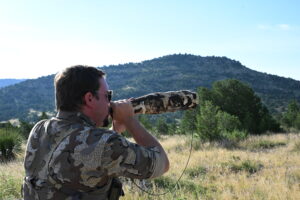
Guide Clayton Kibbe bugles to locate elk on Day 1 in West Texas.
The landscape was surprisingly greener than I had thought, thanks to some good rain over the previous weeks.
Now and then, Clayton would stop the truck, get out and call, using his bugle to locate elk. We would glass the mountains and hills in search of big bulls.
If we saw a good bull, we would conduct a stalk to get closer to determine if he was a shooter.
“We try to look for bulls that are 300 inches or better,” Clayton informed me while driving up another bumpy road to glass.
Although we saw a plethora of elk that day, we were never able to find a mature bull.
So, we made our way back to camp, had some fantastic meatloaf for dinner and listened to a success story of one of the other hunters, Ian Doran of Trijicon, who had taken a fine bull that morning with guides Mike and Ted Simpson.
On Day 2, we woke up to coffee and breakfast by chef Rhonda Eckert. The guides discussed the day’s plan and eventually decided we should try out another part of the ranch, just across the highway from where we had hunted the previous day.
Just like the day before, as we pulled into the gate at sunrise, the sound of bugling bull elk greeted us. Hearing a bugling elk in the wild has to be one of the most extraordinary things I have ever experienced. Their dialogue is unique and high-pitched, almost like a scream.
After about an hour of glassing, we spotted a few decent bulls early in the flats but decided to keep moving in search of a bigger mature bull.
As we made our way down the road, we scanned the area meticulously.
Clayton suddenly stopped the truck.
“Did you hear that? It sounded like one or two bulls,” he said.
But this part of the ranch was thick and flat, so we were unable to gain elevation and couldn’t see anything in the dense brush.
We exited the vehicle, and Clayton decided we should move on foot into the thick stuff to get a better look at what was in there.
Not in my wildest dreams would I have expected what would happen next!
Eddie, his son Wesley, cameraman Jose Ramirez and I stayed in a tight line behind Clayton as we made our way into the thick mesquite maze.
When we finally got to a small clearing, we stopped and Clayton let out a cow call.
Immediately, a bull responded, and he sounded close. Clayton motioned for us to take cover behind some brush as he set up the shooting stick and told me to get ready.
As I placed the rifle on the shooting sticks — a Springfield Model 2020 Boundary chambered in .300 PRC — I began to shake uncontrollably with excitement.
I looked through the Trijicon AccuPoint 3-18×50 scope and tried to find the bull in the thick brush but couldn’t. Then, the bull let out another loud bugle before slowly stepping out, walking right at us.
I tried to calm my nerves as he made his way closer before stopping in front of us at 12 yards.
I had never been so close to a bull elk in my life. I could smell his musk and could see the drool coming from his mouth.
“Should I take the shot?” I whispered to Clayton.
“No, he’s a young 6×6, not very wide. He’s not what we are looking for,” he replied.
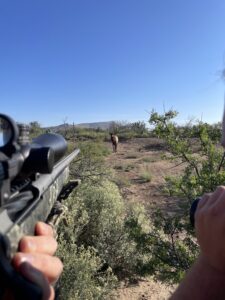
One of many close encounters the hunting party had during their stalk of a mature bull.
We stood still, none of us moving a muscle, as we were in a standoff with the bull for about 3 minutes before he eventually caught our wind and trotted off.
We continued forward slowly in a tight line, weaving our way through the tall grass, catclaw and mesquite, trying to hold twigs and branches for the person behind so they wouldn’t get wacked.
Clayton was periodically making cow calls as we walked, and we could hear more bulls up ahead responding to the call.
Once we reached another small opening, Clayton set up the shooting sticks for me while continuing to cow call.
As I got on the sticks, suddenly another 6×6 bull came running to our right and stopped at about 20 yards.
He was a good bull, but it was so thick I did not have a clear shot.
We remained still, but eventually he caught our scent and moved off. So, we continued forward.
The action was nonstop. We were covered in elk in every direction.
Clayton heard another bugle in the distance that he wanted to check out.
As we made our way forward, the bull continued to bugle and began to sound close.
My heart was racing, and my hands were sweaty as we got within 30 yards of the bugling bull but still had no eyes on him.
“I think he’s bedded down over there behind those junipers,” whispered Clayton as he put up the shooting sticks.
As we got set up on the bedded down bull, out of the corner of my eye, I noticed antlers moving through the thicket to my left.
It was yet another bull who was curious and wanted to check out what all the commotion was about.
I had the rifle facing towards the bedded down bull and couldn’t move as the 5×5 stared us down for a few minutes before eventually winding us and moving off.
We had now had three close encounters and had yet to pull the trigger!
Our hunting party continued to wait patiently, hoping the bedded-down bull would eventually get up to give us a chance to take a shot.
After a few minutes, I could tell Clayton was getting antsy.
“I don’t think he’s going to get up on his own. We are going to have to push him out of his bed,” said Clayton.
“Push him out of his bed?” I imagined getting too close and having to defend myself from a 700-plus-pound animal.
“Come on,” said Clayton as we slowly crept forward to where the bull was bedded.
When we got to about 10 yards from him, suddenly, the bull let out a piercing bugle.
Clayton’s eyes got wide, and he quickly motioned us to retreat to where we were originally set up.
The five of us ran back like chickens with their heads cut off, and I got set up on the sticks behind some mesquite.
Clayton continued to cow call from behind me.
I first noticed a cow making her way right to left through the thicket about 20 yards. Then, I looked behind her to see giant antlers weaving through the mesquite and juniper.
I tried to slow my breathing as I knew this would likely be the moment I had been waiting for.
As the cow made her way through, the bull was right on her tail.
I could now see his massive head and neck, but the vitals were still blocked by all the brush.
“When you get a clear shot on his shoulder, kill him,” whispered Clayton.
The bull slowly moved forward and stopped to look at us at 17 yards, providing a small window to his shoulder through the brush.
I placed the crosshairs on the bull’s shoulder and slowly squeezed the trigger.
At the crack of the rifle, the big bull jumped back and ran into the thicket where he had been bedded with his cow.
“Did I hit him?” I asked nervously of the viewers behind me.
“You smoked him,” said Eddie with a big smile on his face.
We waited a minute or two, then began tracking the big bull who had run into some thick thorns and brush.
After a few minutes and a little worrying that we wouldn’t find him because it was so thick, we finally found the expired bull just 40 yards from where the shot was taken.
High fives, hugs and shouts of excitement erupted in the desert.
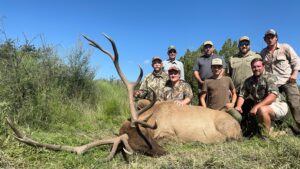 Backup was eventually called in by radio after the successful stalk. From left to right are Mike Lassig, Ted Simpson, Jack Orloff, Eddie Stevenson, Wesley Stevenson, Ian Doran, Clayton Kibbe and Jose Ramirez.
“To get a bull elk and to be able to call them in and get them in close, and the experience of the bull bugling up close like that, it’s just so exciting for a hunter and makes them come back again and again,” said Mike.
I ran my hand along the big bull’s side and up his antlers, taking in every detail of the incredible animal lying before me.
It was my first bull elk, which was a beautiful, wide, mature 6×6 with a small kicker off his right G4.
I thanked the animal and God for the opportunity and the incredible 30 minutes of hunting that had just played out.
Now, whenever I think of Texas, a big, rut-crazed bull elk comes to mind.
The Scope
Trijicon AccuPoint 3-18×50 Riflescope
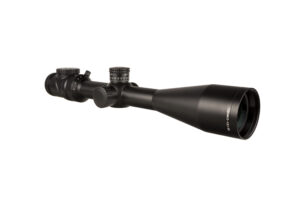
Whether you’re hunting out West or in your backyard in the East, the AccuPoint 3-18×50 can handle almost everything that comes its way.
It features a Second Focal Plane (SFP) MOA Ranging Reticle with a green dot, a 30mm tube and a satin black finish, with exposed elevation and a return-to-zero feature.
What I found most notable about the AccuPoint 3-18×50 is that it provides hunters with the ability to accurately extend their range in any lighting condition without batteries.
Every AccuPoint scope has an advanced fiber-optic and tritium-illuminated reticle that enhances target acquisition and extends shooting time in low-light conditions. The dual-illumination system automatically adjusts the aiming-point brightness to match the existing lighting conditions on your hunt.
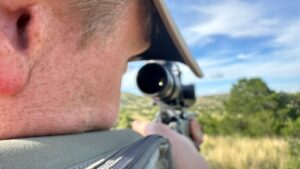
The scope also has great clarity, with its multi-coated broadband anti-reflective glass.
The aircraft-quality, hard-anodized aluminum body provides weather protection against the elements hunters face, and if you drop it, you can be sure that the scope will maintain zero.
Its clarity, durability, fiber-optic and tritium-illuminated reticle made this scope a good match for my hunt in the Wild West.
— Jack Orloff
The Rifle
Springfield Model 2020 Boundary
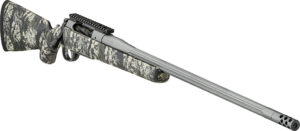
Springfield’s Model 2020 Boundary is built on a custom-grade Model 2020 action and is available in long and short action configurations backed by the company’s .75 MOA guarantee.
It’s available with a choice of either a lightweight carbon fiber or a traditional fluted stainless steel free-floated barrel.
The action has dual locking lugs on a fluted bolt that runs down EDM raceways and the optimized extraction cam ensures smooth operation in most conditions.
The barreled action on the Model 2020 Boundary is fitted to the carbon fiber AG Sportsman stock with hand-painted Rogue camouflage. It has a 13.5-inch length of pull, along with two QD cups for quick sling attachment and a 1-inch Pachmayr Decelerator Pad that reduces felt recoil for enhanced shooting comfort.